I promised in the introduction that we would start with goal setting, and that we would do it in the simplest way I know. So here is the whole chapter in one sentence, in case you get distracted and wander off: you will not pick a direction until something forces you to, and the cheapest thing available to force you is the fact that you are going to die.
Sorry. I did say the guide was about minimising regrets before we die. I was not being cute.
For most of my life I was, as I put it in the introduction, a hyperactive ostrich, banging my head into every wall society had on offer, spending most of my school days in the principal's office, and eventually dropping out of university with no plan whatsoever. What I want you to notice about that description is that none of it is a goal problem. It is a direction problem. Nobody in the principal's office ever failed at their goals. They just never had any, so every wall looked equally worth headbutting.
Death fixes that, and it is free.
Step 0: the arithmetic, which takes 30 seconds and ruins your afternoon
Pick the age you think you will live to. Subtract your age now. Multiply by 52. That number is roughly how many weeks you have left.
If you are 30 and you are hoping for 80, that is about 2,600 weeks. If you are 45, it is about 1,820. Tim Urban drew this out as a grid of little boxes in Your Life in Weeks, and I recommend looking at it once and then not looking at it again for a while, because a whole human life fits on one page and it is not a large page.
People usually react to this in one of 2 ways. Either it lands as panic, which passes in a day and changes nothing, or it lands as clarity, which is the useful one. The difference is entirely whether you write something down in the next hour. So let us write something down in the next hour.
Step 1: borrow the regrets of people who already ran out of weeks
Here is the shortcut, and it is the reason I am not asking you to invent your values from a blank page at 11pm. Other people have already done the experiment. Bronnie Ware spent years in palliative care, with people in the last 3 to 12 weeks of their lives, and she wrote down what they said they wished they had done differently. Her top 5 regrets of the dying, in her words:
I wish I'd had the courage to live a life true to myself, not the life others expected of me.
I wish I hadn't worked so hard.
I wish I'd had the courage to express my feelings.
I wish I had stayed in touch with my friends.
I wish that I had let myself be happier.
Read that list twice and notice what is not on it. Nobody wished they had earned more. Nobody wished they had been more impressive, or won the argument, or got the bigger title. The regrets are all about courage, other people, and permission.
I am not telling you those 5 are your 5. I am telling you that they are a much better starting point than nothing, and nothing is what most of us start from.
What you must not do is take somebody else's finished answer. Tim Urban has the best description of this I have read, in How to Pick a Career (That Actually Fits You): a cook follows a recipe somebody else wrote, a chef reasons from the ingredients up. Most of us pick a life the way a cook picks dinner, by copying the recipe of whoever was standing nearest, and then we wonder why it does not taste of anything. Copy the regrets, which are data. Do not copy the life.
Step 2: write the 5 sentences
Now the actual exercise, and it is small on purpose.
Imagine you are at the end. Not dramatically, just at the end. Write down the 5 sentences you would want to be true about your life. Not what you would want on a headstone, which makes everybody write something embarrassing about being a good person. Sentences a specific human being who knows you would say out loud, without lying.
Things like: he was there when it mattered. She built something that outlived the funding. He stayed curious after it stopped being cool. She was the friend who actually showed up. He was not afraid of the thing he was afraid of.
5 sentences. 10 minutes. Do not make it beautiful, make it true.
This is not my idea, and I said in the introduction I would not reinvent the wheel. Stephen Covey built an entire habit on it. His second habit, Begin With the End in Mind, is described on his own site like this: "If we don't make a conscious effort to visualize who we are and what we want in life, then we empower other people and circumstances to shape us instead." His version of the output is a personal mission statement, which he calls writing your own personal constitution. Mine is 5 sentences, because I will actually finish 5 sentences.
Step 3: split the life into areas, because "be better" is not a plan
The problem with a mission statement on its own is that it sits at the wrong altitude. It is true and it is unusable, like a map of the world when you are trying to find the toilet.
So take your life and cut it into areas. You will find a version of this exercise in a hundred books and it genuinely does not matter which list you use. Mine is 8:
- Health, meaning the body you have to live inside for all the remaining weeks.
- Money, meaning security, not score.
- Work, meaning what you spend your days making or fixing.
- Relationships, meaning the 5 or 6 people whose opinion of you actually changes your week.
- Play, meaning the things that are fun and produce nothing.
- Growth, meaning what you are getting better at on purpose.
- Place, meaning where you live and who is around you.
- Contribution, meaning what you do that is not for you.
For each area, do 2 things. Score it out of 10 as it is today, honestly, in 5 seconds, first number that arrives. Then write 1 sentence describing what a 9 would look like. Not a 10. A 10 is a fantasy and fantasies do not generate plans.
By the time you have done that you are holding the thing the introduction promised: an initial impression of the kind of life you aspire to lead, in your own handwriting, in about 40 minutes. That is the entire goal of this chapter. If you stop reading here you have got what you came for.
Step 4: cut it down to 3, and this is the part everyone skips
You now have 8 sentences describing a better life and 8 scores telling you where the gaps are. The temptation is to attack all 8. Do not do that. I have done that. It feels tremendous for 9 days.
Look at the gaps between today's score and the sentence you wrote, pick the 3 largest, and turn only those 3 into goals for the next 12 months. Write each one so a stranger could tell whether you did it. "Get fitter" is not a goal, it is a mood. "Walk 8,000 steps a day on 5 days out of 7" is a goal, because it can fail, and a thing that cannot fail cannot succeed either.
Leave the other 5 areas alone. They are not abandoned, they are queued. You will come back to this list in a year, which is soon, because you have already counted the weeks.
And once you have the 3, hold them lightly, because the goal is not the part that does the work. James Clear puts it well in Goal Setting: A Scientific Guide to Setting and Achieving Goals, using a rowing boat: the rudder sets your direction, the oars make the progress. Your 3 goals are the rudder. What you actually do on an ordinary Tuesday is the oars. A year from now the goals will have got you pointed correctly and the Tuesdays will have got you there, and if you only ever set the rudder you will finish the year pointing beautifully at nothing.
Complexity is the enemy of execution. It was true in the introduction and it is the whole reason this chapter ends at 3 goals instead of 8.
What to do with all this
Put the 5 sentences and the 3 goals somewhere you are forced to see them, which for most people means the thing they look at 80 times a day rather than a beautiful notebook they look at twice a year.
Then carry on to Chapter 2, which is about time, and about why the shortness of life is mostly a story we tell ourselves about how we spend it. You have just counted your weeks. The next chapter is about what quietly eats them.
One last thing, in the spirit of the introduction's warning about my lack of academic rigor. None of this is a promise that you will get the life in your 8 sentences. It is a promise that you will stop drifting toward a life nobody chose, which, going by Bronnie Ware's list, is the thing people actually regret at the end. Aim at something. Anything beats headbutting walls, and I say that as a professional.
Your Next Tiny Step
If you want this to stick for the next 14 days, and the next 14 years, you need either the discipline of a Shaolin monk OR just a cadence and a partner.
That's why I created Simple Guide: so you'll always have that partner, accountability, and a clear next step.
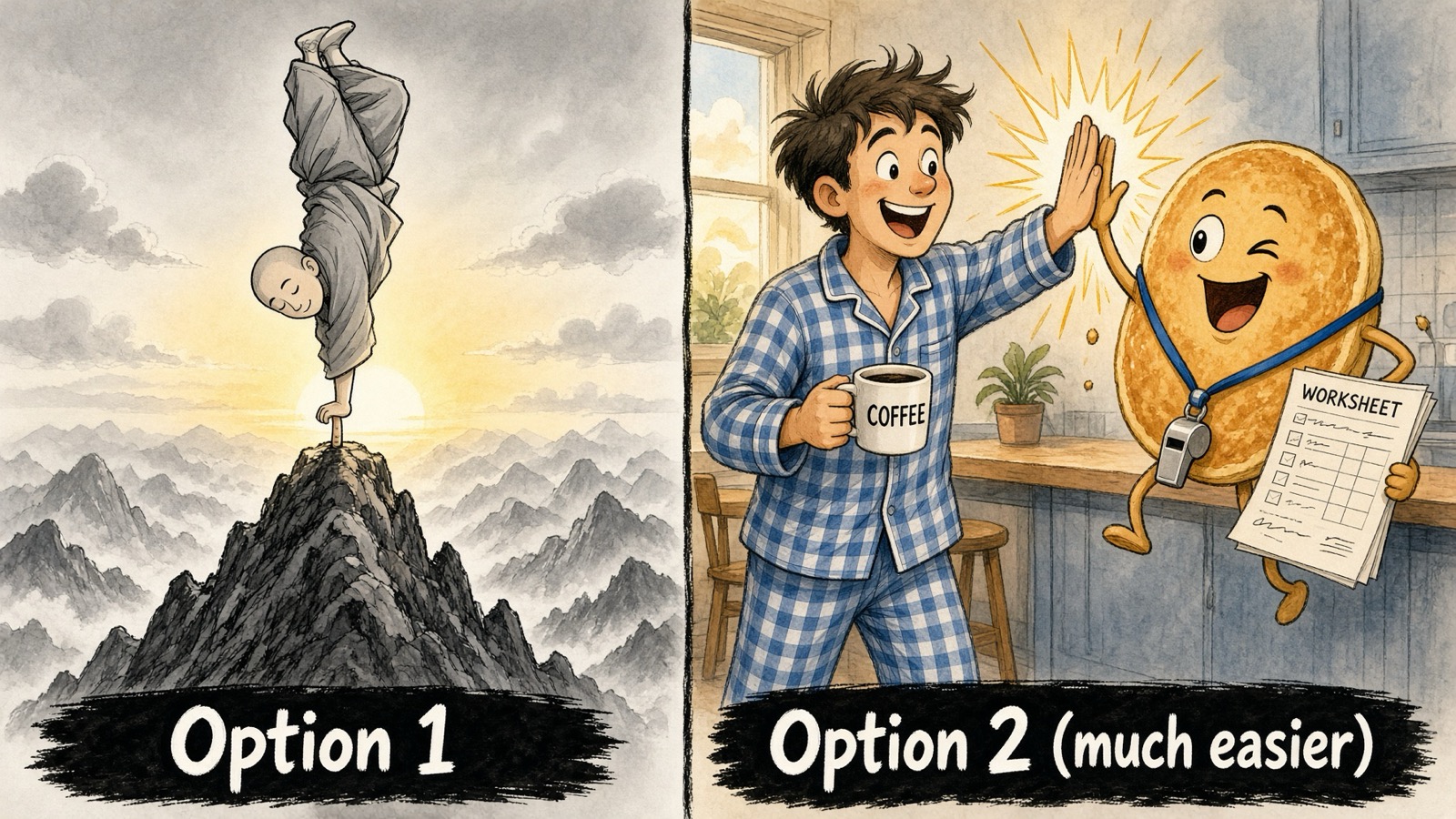
Step 1: Download the free 20 Minute Burnout Worksheet. It takes about 20 minutes, a pen, and your honest attention. You'll name what's actually draining you, sort it into the part you can fix and the part only your job's shape can fix, and pick the 1 thing to change first.
Step 2: Book a call with me. We'll map your values, redesign your goals, and craft your next steps, together. It's the same process that got Karla, Alessandro and Andrea jumping out of bed to tackle goals that make them feel alive, instead of the snooze, scroll, repeat routine.
Compared to 80,000 hours of potential regret, 1 worksheet and 1 conversation are a rounding error in your life's investment portfolio.
Because those boxes on the life-in-weeks chart don't wait for anyone.
So take that 1 tiny step today.