Here's a confession that took me way too long to make.
By the end of the last chapter, I had done the things. I had set my goals, faced the shortness of life, fear-set my way through the scary parts, and built the habits to keep me moving. I had started a business. I was traveling the world. I was healthier than I'd ever been.
And there were still mornings I woke up feeling like a flat pancake.
Not burnt, like the version of me who overworked himself into the ground chasing approval from teachers he didn't even like. Not raw, like the version who spent years "thinking about it." Just flat. Cooked, technically. Hitting the goals, technically. Quietly wondering, "Wait, is this it?"

That's when I realized I'd made the same mistake almost everyone makes. I had treated happiness like a destination. A finish line I'd cross once enough goals were checked off. But every time I crossed one, the finish line moved. Like a treadmill. Or a cat you're trying to photograph. Or that one airport gate that changes 4 times while you sprint through the terminal carrying a neck pillow.

Happiness, it turns out, isn't a single ingredient. It's the whole damn pancake.
Why Should You Care?
Remember the 3 most common regrets of the dying from Chapter 1?
- "I wish I'd had the courage to live a life true to myself, not the life others expected of me."
- "I wish I hadn't worked so hard."
- "I wish I'd let myself be happier."
That last one haunts me. Let myself. As if happiness was always available, and they just never gave themselves permission. Like a gym membership you paid for every month for 40 years and never once used. Except the gym was joy, and the membership was your entire life.
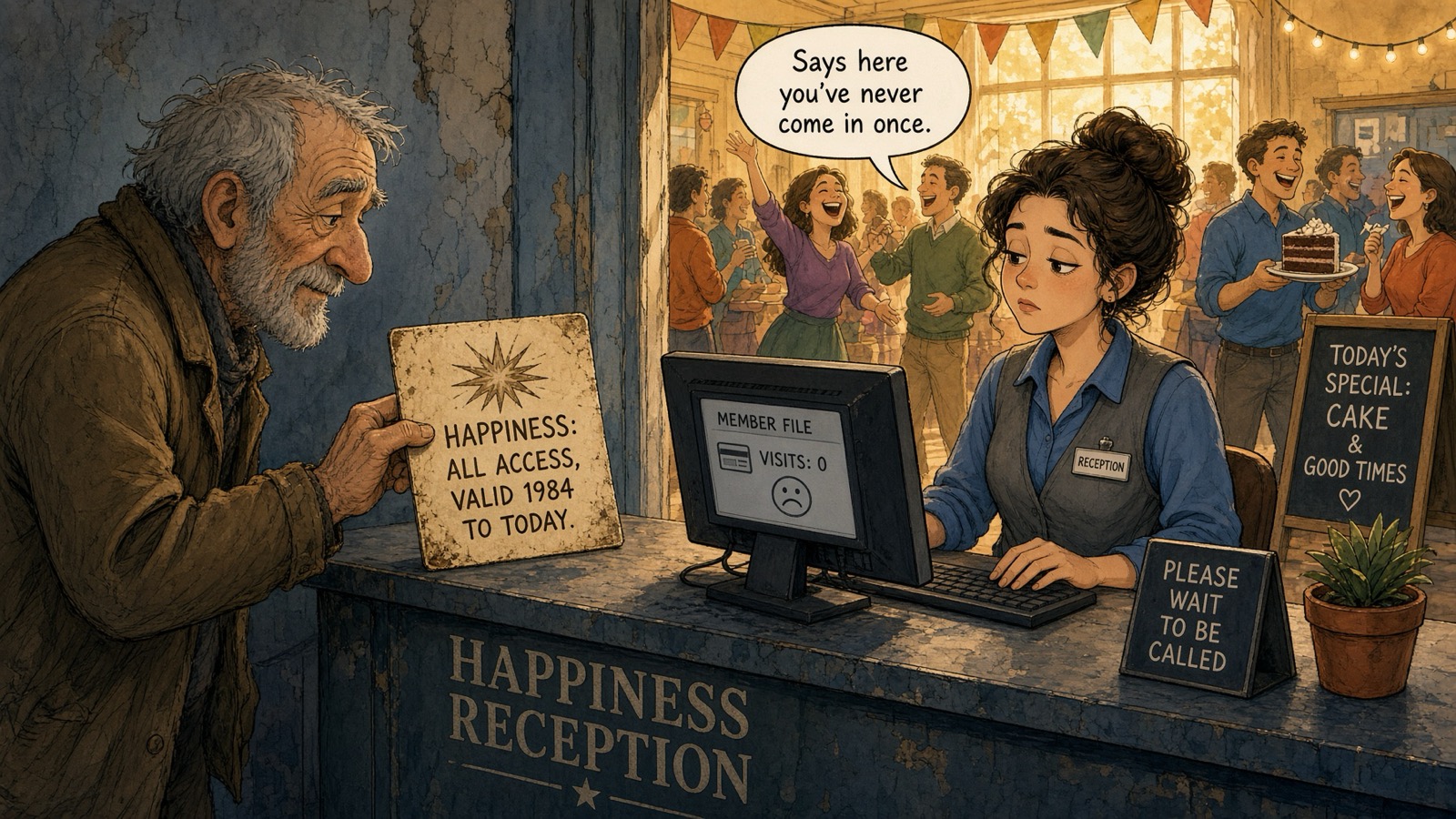
As we covered in Chapter 2, life is too short to delay gratification until retirement. Most of us are running a plan that looks like this: suffer for 40 years to earn the right to enjoy the last 20, if we're lucky, from a hospital bed.
Henry David Thoreau saw it coming over 170 years ago:
"This spending of the best part of one's life earning money in order to enjoy a questionable liberty during the least valuable part of it, reminds me of the Englishman who went to India to make a fortune first, in order that he might return to England and live the life of a poet. He should have gone up garret at once." Henry David Thoreau, Walden
Translation: if you want to be a poet, go be a poet. Now. Don't spend 30 years in a job you hate so you can maybe write poems when your hands shake too much to hold the pen. At that point your poetry is 1 long sonnet about your hip replacement.

I feel most alive when I'm enjoying every single day, savoring life, and learning about and exploring the world. So I needed a way to live like that as soon as possible and keep living like that for the rest of my life, not just in retirement.
Like Thoreau, I realized 3 things could wreck that plan:
- Dedicating myself solely to making and saving money.
- Taking on big, irreversible responsibilities before I was ready.
- Neglecting my health.
So I set out to learn everything I could about happiness, and to build a life and career around freedom, financial and otherwise, so I'd have the best shot at being happy both today and in the long run.
Demystifying Happiness
Here's what most people get wrong about happiness: they think it's 1 thing. Get rich. Find your purpose. Practice gratitude. Achieve your goals. Fall in love. Move to Bali. (Plenty of people have moved to Bali to find happiness. Many are still looking. Some are now selling courses about it.)
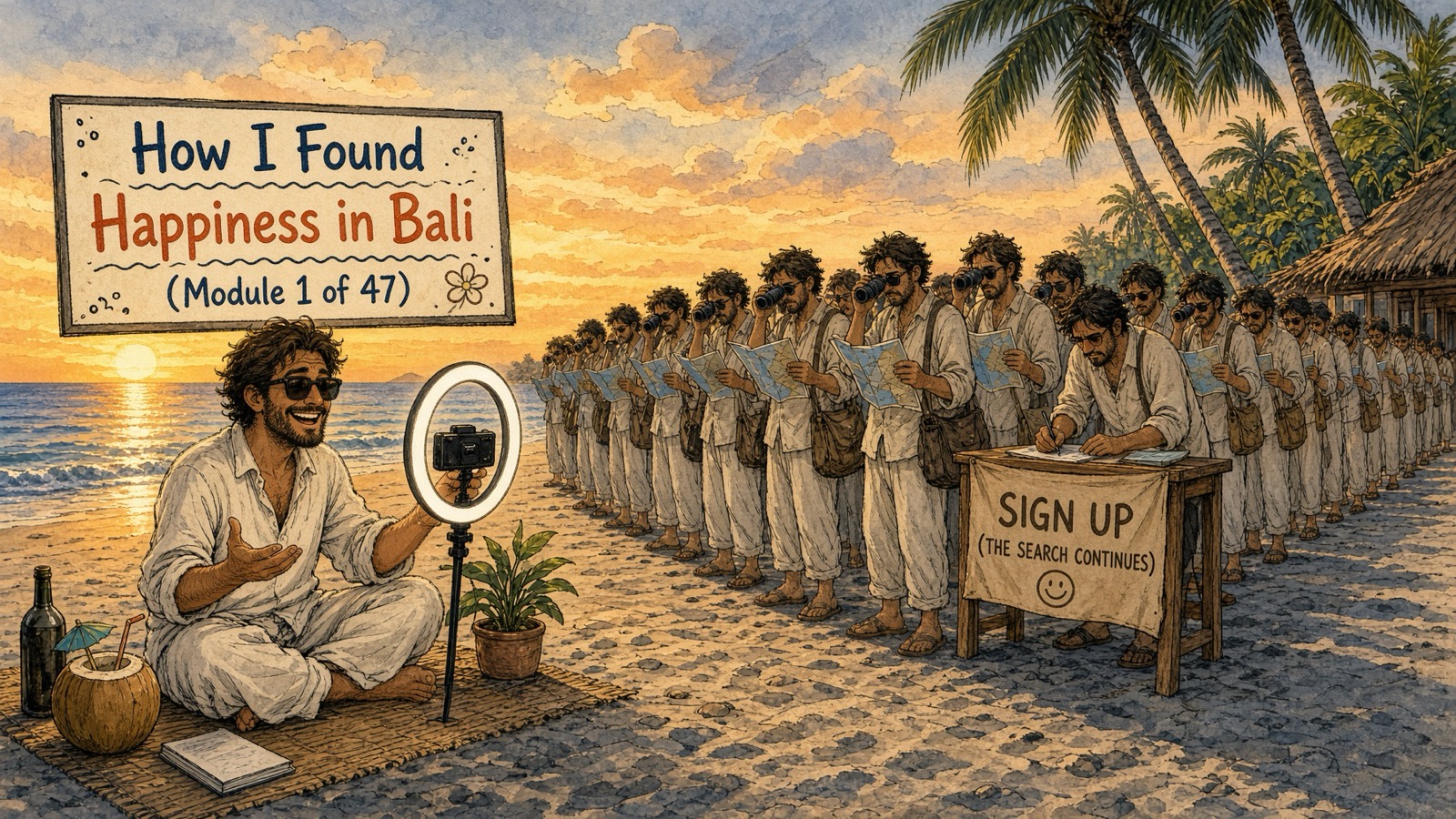
Each of those is an ingredient. None of them is the pancake.
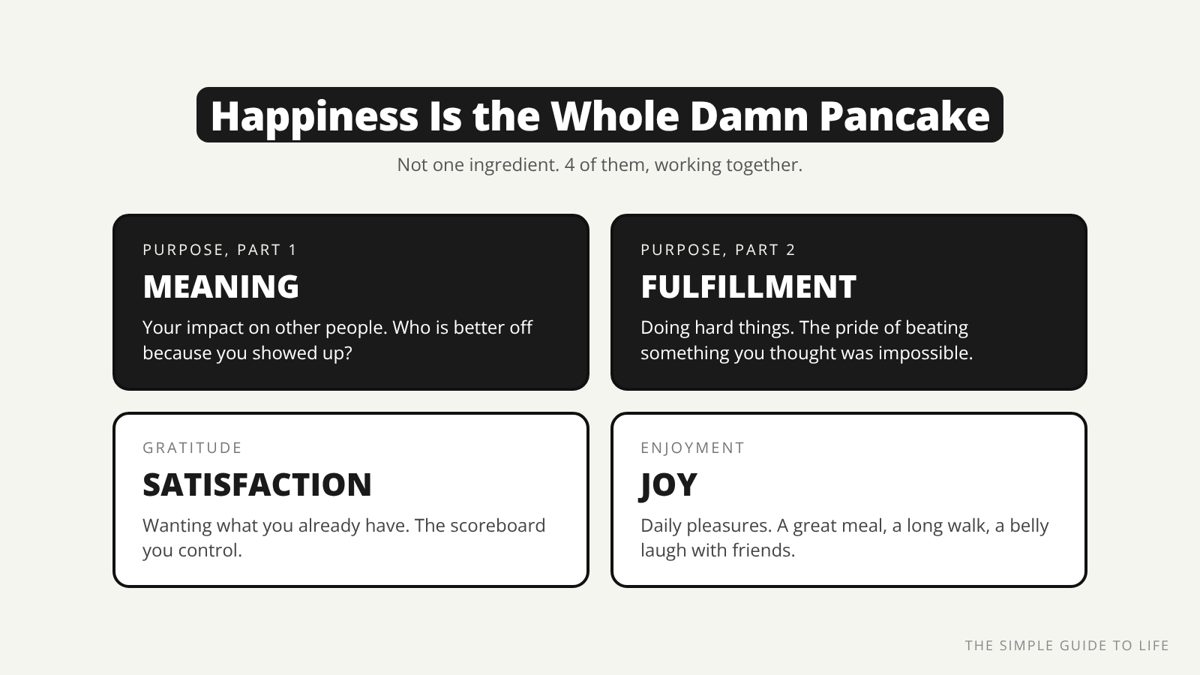
The breakdown that finally made it click for me came from combining the work of Arthur C. Brooks, the Harvard professor who teaches the science of happiness, and Mo Gawdat, the former chief business officer at Google X who wrote Solve for Happy. Here's my simplified version. Happiness has 4 parts:
- Meaning: your impact on other people. Who is better off because you showed up?
- Fulfillment: doing challenging things. The deep pride of overcoming something you once believed was impossible.
- Satisfaction: being grateful for what you already have.
- Joy: daily pleasures. A delicious meal. A long walk in a new city. A belly laugh with friends that makes your drink come out of your nose. (Ideally not at a wedding, and ideally not in the direction of the cake.)

Meaning and fulfillment together make up what most people call purpose. That's the long-term happiness. Satisfaction and joy are the shorter-term kind.
Personally, I've always felt happiest when I prioritize the long-term kind (meaning, fulfillment, and gratitude) over the short-term kind (joy). But here's the catch: you need all 4. A life of pure purpose with no joy is a burnout waiting to happen. A life of pure joy with no purpose feels hollow within months. And no amount of either makes up for never feeling satisfied with what you have.
A few ideas that rewired how I think about each one:
- Satisfaction is a math problem. Arthur Brooks describes satisfaction as what you have divided by what you want. Most of us try to increase the top number forever. The faster lever is managing the bottom one. Nobody has ever been made happier by a 4th air fryer.

- Expectations are the enemy of joy. Mo Gawdat frames unhappiness as the gap between what happens and what you expected to happen. You can't always control the events. You can work on the expectations. If you expect your 6-year-old's birthday party to be a calm, elegant affair, the problem isn't the 14 kids screaming on a sugar high. It's you.
- Your values are pendulums. Also from Mo Gawdat: every core value has a point of balance. Too little courage is cowardice. Too much is recklessness. A lot of unhappiness comes from a value that's swung too far in 1 direction.
- Relationships are the backbone. Robert Waldinger directs the Harvard Study of Adult Development, which has followed the same people for most of their lives. His biggest lesson is the simplest: the quality of our relationships shapes how happy and healthy we are, more than almost anything else.
- Experiencing isn't the same as remembering. Daniel Kahneman showed that the "you" living each moment and the "you" looking back on your life judge happiness differently. A good life needs both a pleasant present and a story you're proud of.
"Love is saying yes to what is." Richard Rohr
Feed Every Level, Every Day
Knowing the 4 parts of happiness was one thing. Actually living them, on a random Tuesday, was another.
So I simplified. I divided my needs into categories using Maslow's hierarchy of needs, including the level Maslow added near the end of his life, self-transcendence.
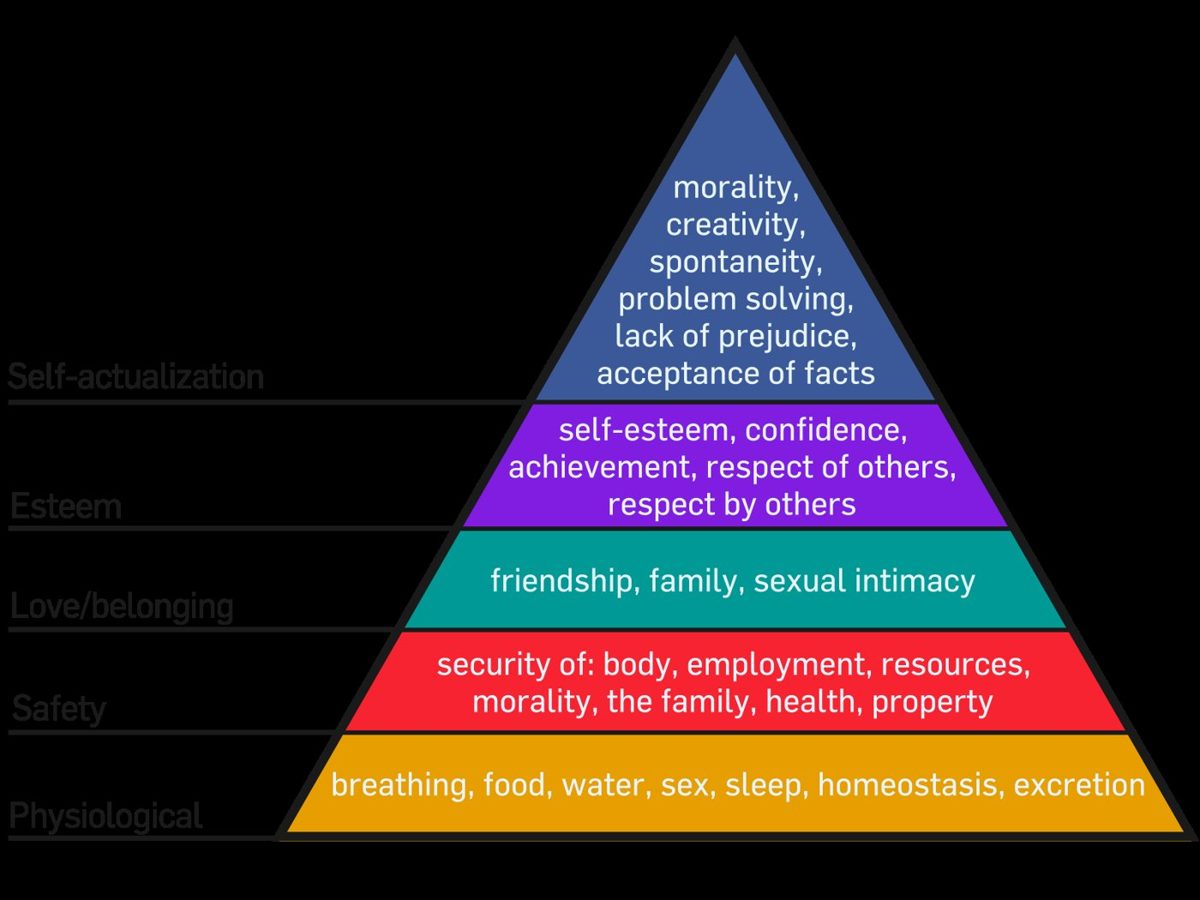
Here's the twist. Most people play the pyramid like a video game: beat level 1, unlock level 2. Grind on money and career until 40, then worry about relationships, then maybe think about meaning when you retire. By the time you reach the final boss, your controller is broken, your teammates have logged off, and your character is asleep in a recliner by 8:30 PM.
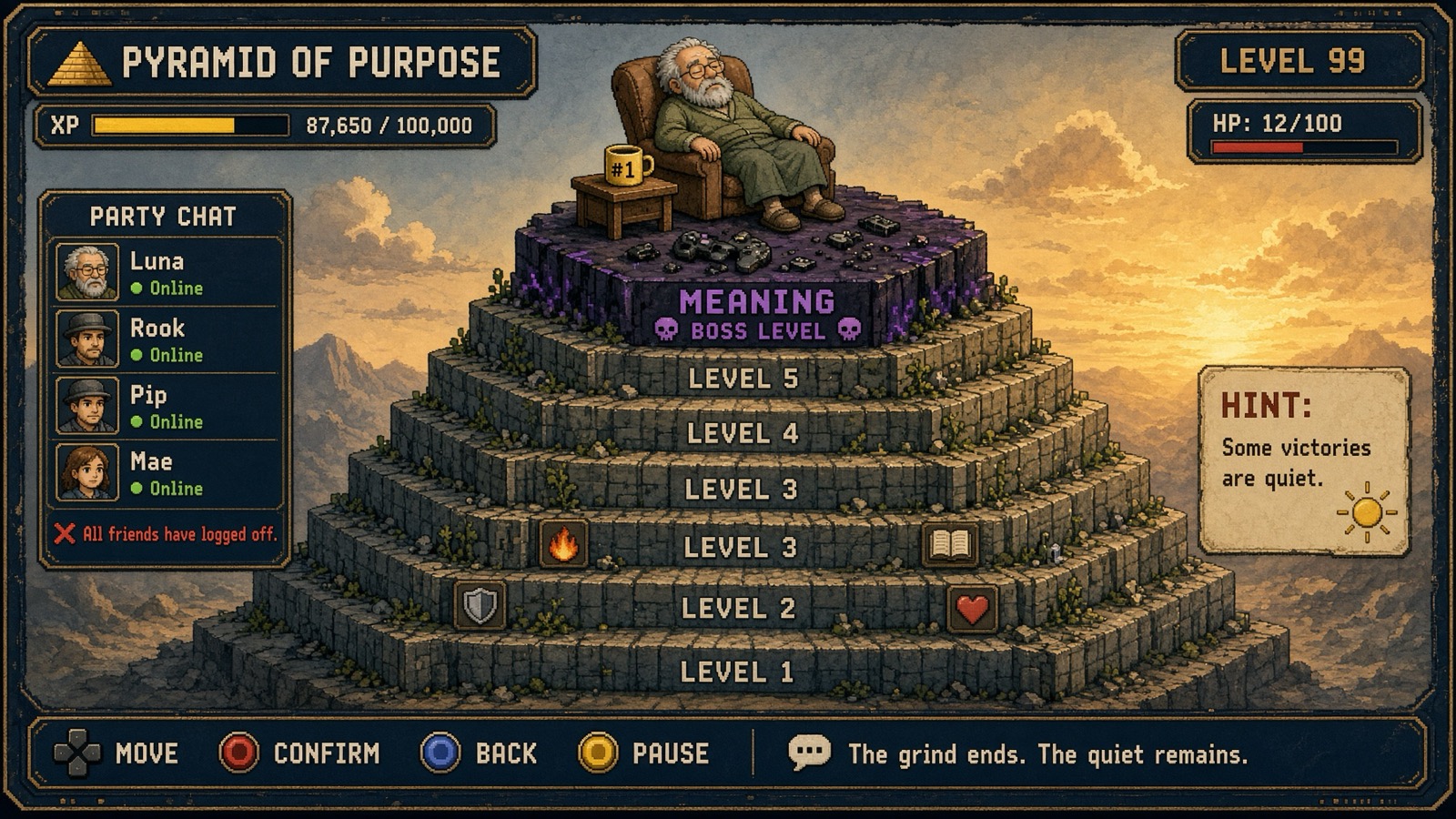
I did the opposite. I prioritized my time across every level of the pyramid, every day, every week, every month, and every year, instead of focusing on 1 level at a time.
I got the idea from listening to hundreds of hours of interviews on The Tim Ferriss Show and similar podcasts. So many of the happiest and most "successful" people had a daily routine that touched almost every level before lunch: they moved their body, took care of their finances and work, connected with people they loved, learned something, and did something that mattered to someone else. They weren't saving happiness for later. They were taking a small dose of all of it, every day, like a multivitamin for the soul (but without the horse-pill size that makes you question your will to live).

So that's what I built. Here's what each level looks like for me in practice:
- Physiological: sleep, movement, real food, deep breathing. Remember from Chapter 4: change your state, change everything.
- Safety: money working for me while I sleep, a financial cushion, and a plan, so I never have to think twice about a surprise bill.
- Love and belonging: a partner, a close-knit crew who push me to grow and let me be ridiculous, and a community. (Every human needs at least 1 friend they can send a 4-minute voice note to about absolutely nothing.)
- Esteem: earned pride from doing hard things well, not from likes or titles. (Nobody's tombstone says "Senior Vice President of Strategic Synergies, 47 endorsements for Microsoft Excel.")
- Self-actualization: learning, creating, and chasing the "impossible" goals from Chapter 1.
- Self-transcendence: helping people who've struggled the way I have, and leaving the world better than I found it.
You can't optimize your way to happiness, and you can't just meditate your way to freedom. A spreadsheet that tracks your happiness to 2 decimal places will mostly make you unhappy, and no landlord in history has accepted inner peace as rent. You need wisdom to stay sane and systems to stay free.

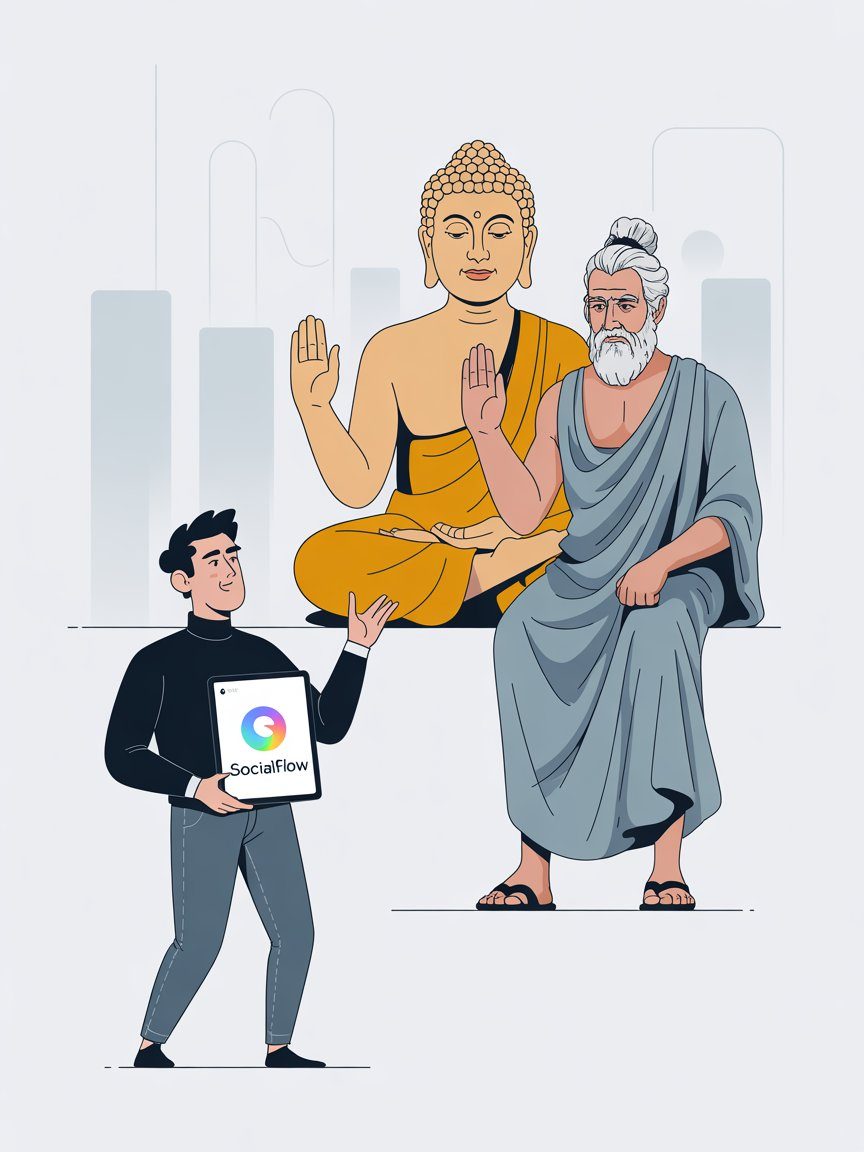
- Wisdom: Stoicism, Buddhism, and the philosophies that have worked for thousands of years teach the inner game: how to be present, grateful, resilient, and at peace no matter what life throws at you. Way before productivity apps existed, humans somehow figured out how to live meaningful lives. Marcus Aurelius ran the entire Roman Empire without a single Notion template. Wild, right?

- Systems: wisdom alone doesn't pay rent. You also need the outer game: invest, automate, delegate, eliminate. Money working for you, systems handling the boring stuff, other people doing what they're better at, and cutting the tasks that don't actually matter (looking at you, meeting that could have been an email that could have been nothing). That's what buys you the time and freedom to pursue purpose and joy without burning out again.
Wisdom keeps you satisfied. Systems give you the freedom to find meaning, fulfillment, and joy. Together, they make a pancake that's both delicious today and sustainable for decades.
Fulfillment, Satisfaction, and Joy: How I Practice Them
Fulfillment. My strongest, longest-lasting feelings of fulfillment have come from overcoming obstacles I first believed were impossible. Climbing Kilimanjaro. Cycling across Vietnam. Building companies from nothing. Walking out of that exam hall and making the gap year actually work. (Kilimanjaro, by the way, is the only place where "I can't feel my legs" and "best day of my life" are said in the same breath.) But fulfillment doesn't require a mountain. It can come from putting real effort into anything and being proud of yourself or the result.


Satisfaction. When I was 12, I went to survival camp. All of life's comforts were stripped away: no bed, no fridge, no screens, sometimes no dinner. When I came home, I was grateful for everything I'd taken for granted. A hot shower felt like a spa. A sandwich felt like a 5-star meal. My own bed felt like a cloud handcrafted by angels, which is a big upgrade from the pile of leaves I'd been sleeping next to.

That lesson stuck. Today, the most reliable way I've found to feel satisfied is a short daily gratitude practice. It's hard to feel unhappy when I'm genuinely grateful.
Joy. I use "joy" for all the short-term happiness habits that don't fit the other categories: mindfulness, morning rituals, savoring a great meal, a long walk where my phone stays in my pocket (revolutionary concept, I know). Joy is the syrup. It's not the whole pancake, but life is pretty dry without it. And no, 3 hours of scrolling doesn't count as joy. That's not syrup. That's the sad, watery stuff at the bottom of the plate.

The Resources
Here are the resources, in order of priority, that helped me with every part of "happiness." I highly recommend going through each of them directly.
Physiological and Safety Needs
Health
- The 4-Hour Body | Tim Ferriss
- The Huberman Lab Podcast | Andrew Huberman
- Super easy morning routine fundamentals
Financial security
- I Will Teach You To Be Rich | Ramit Sethi: the book is a great single resource, and the courses and podcast are worth it too.
- Principles | Ray Dalio, especially How the Economic Machine Works
- Unshakeable | Tony Robbins
- The Motley Fool
Love and Belonging Needs
Getting into a relationship
- How to Pick a Life Partner, Part 1 | Tim Urban
- How to Pick Your Life Partner, Part 2 | Tim Urban
- The Marriage Decision: Everything Forever or Nothing Ever Again | Tim Urban
Sustaining a relationship
Social life
Esteem, Self-Actualization, and Self-Transcendence Needs
General happiness
- Solve for Happy | Mo Gawdat
- Harvard Professor Answers Happiness Questions From Twitter | Arthur C. Brooks for WIRED
- 7 Life-Changing Lessons From the Longest Study on Health and Happiness | Dr. Robert Waldinger on The Diary of a CEO
- Laurie Santos: The Pursuit of Happiness | The Knowledge Project
- Stumbling on Happiness | Daniel Gilbert
- Happiness | Naval Ravikant
Purpose, meaning, and existentialism
- Man's Search for Meaning | Viktor Frankl
- The Rational Optimist | Matt Ridley
- A Return to Love | Marianne Williamson, especially her point that when we attach value to money, cars, houses, and prestige, "we are loving things that can't love us back."
- Winning at the Great Game with Adam Robinson | The Knowledge Project, from his book An Invitation to the Great Game
Fulfillment
- Predictably Irrational | Dan Ariely
Satisfaction and gratitude
- Outward Bound: the closest thing to the survival camp that taught me gratitude at 12.
- Adventure philanthropy: trips that combine a physical challenge with volunteering. The organization I loved most for this, Roadmonkey, no longer operates, but plenty of others follow the same model.
- The 5-Minute Journal: the simplest way I've found to practice gratitude every day.
Joy
- Mindfulness, in any form:
- 5 Morning Rituals That Help Me Win the Day | Tim Ferriss
- Daniel Kahneman on why most people don't really want to be happy | Quartz
- Why Generation Y Yuppies Are Unhappy | Tim Urban
Here's How I Used the Resources
- I stopped saving happiness for later. Using Maslow's pyramid, I gave every level a small daily dose instead of grinding on 1 level per decade.
- I protected the foundation first. Huberman and The 4-Hour Body gave me the basics: sleep, sunlight, movement, real food. On the days I skip them, every other level wobbles.
- I built financial systems so money stopped running my life. Ramit Sethi taught me to automate my finances and spend extravagantly on what I love while cutting costs mercilessly on what I don't. Ray Dalio helped me understand how the economy actually works, so I stopped panicking at every headline announcing that the economy is either about to explode or has already exploded.

- I chose relationships on purpose. Tim Urban's life partner series made me think about compatibility like the biggest decision of my life, because it is. Esther Perel and the Gottmans taught me that great relationships aren't found, they're maintained. Like a sourdough starter, but with more feelings and fewer Instagram posts.
- I measured my life by meaning, not by a résumé. Viktor Frankl showed me that meaning can be found in almost any circumstance. Marianne Williamson reminded me to stop loving things that can't love me back.
- I chased fulfillment by picking hard, "impossible" goals, then broke them down with the habits from Chapter 4.
- I practice gratitude every day, in writing, in under 5 minutes. It's the cheapest, fastest happiness upgrade I know.
- I schedule joy. A long walk, a great meal, a ridiculous dance party in the kitchen. If it isn't on the calendar, Tomorrow Tony will talk me out of it. Tony thinks "fun" is something you earn after answering 400 emails. Tony is wrong. Tony has also never been invited to a kitchen dance party.

Your Turn: The Happiness Audit
Grab a pen. This takes 5 minutes.
- Score yourself from 1 to 10 on each of the 4 parts: Meaning, Fulfillment, Satisfaction, Joy.
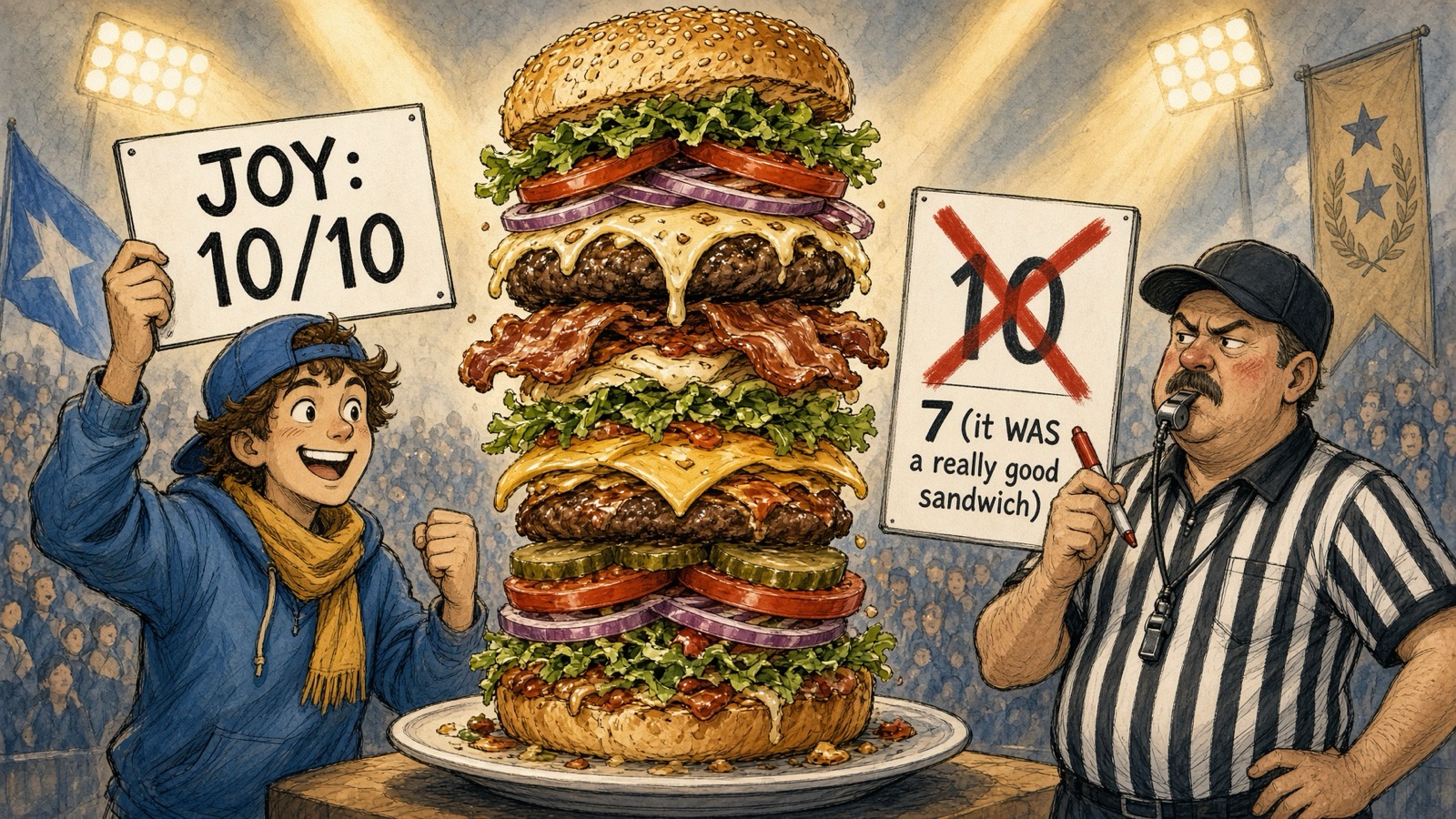
- Circle the lowest score. (No, you can't give yourself a 10 on Joy because you had a really good sandwich today. Okay, fine, maybe a 7.) That's your biggest leak, and probably the reason you sometimes feel flat even when things are "going well."
- Pick 1 tiny habit to feed it, using the recipe from Chapter 4: "After I _____, I will _____, then I _____."
- Low on meaning? After I sit down for lunch, I'll send 1 message helping or thanking someone.
- Low on fulfillment? After my morning coffee, I'll spend 2 minutes on the hardest goal on my list.
- Low on satisfaction? After I brush my teeth at night, I'll write 3 things I'm grateful for.
- Low on joy? After I close my laptop, I'll go for a 10-minute walk without my phone.
Conclusion: Begin With THE End in Mind
That's it. That's the whole guide. Goals, time, fear, change, and happiness, broken down as simply as I know how. 5 chapters, 1 pancake, and an alarming number of sock references.
If this guide can be both your catalyst to go after what you really want and your compass to find your way there, I'll be supremely satisfied.
I want to bring it full circle, back to where we started in Chapter 1: with death.
Victor Cheng, a former McKinsey consultant whose writing has shaped a lot of my thinking, wrote a piece about taking the idea of "beginning with the end in mind" literally. As he put it, "the ultimate way to begin with the end in mind is, to begin with, THE end in mind. On your deathbed, when you look back, what do you want to be true?"
He'd reached the age where he was getting more funeral notices than wedding invitations (a milestone nobody puts on a birthday card), and he shared 3 lessons from it. I'll paraphrase them, because they've stuck with me ever since:
- If you ever get the chance to visit someone who is dying, go. You will never regret saying goodbye, and you may regret not going for the rest of your life.
- People at the end of their lives ask, "Will the people I leave behind be okay?" So take care of that now: insurance, a will, maybe even letters to the people you love. He wrote goodbye letters to each of his kids, and said it gave him enormous clarity about what, and who, truly mattered.
- On your deathbed, you don't think about your résumé. You take an inventory of your relationships: whose lives you touched, who came to say goodbye, who loves you. He told the story of a family friend who, in her final months, asked everyone she loved to come help her family for a week or 2. An endless parade of friends from every chapter of her life flew in. He had no idea what her net worth was, but it was obvious she had lived a remarkably rich life.
I've used everything in this guide to live a life I'm both proud of and grateful for, so far. But only time will tell what ends up in my obituary. Hopefully something better than "Mildly Interesting Sock Collection."

So I'll leave you with the same question I started with:
What do you hope will be true in your obituary, and how much of today belongs in it?
If the answer is "not enough," that isn't just a feeling. That's data, telling you which direction to walk.
Your Next Tiny Step
So here's the deal: if you want this to stick for the next 14 days, and the next 14 years, you need either the discipline of a Shaolin monk OR just a cadence and a partner.
That's why I created Simple Guide: so you'll always have that partner, accountability, and a clear next step.
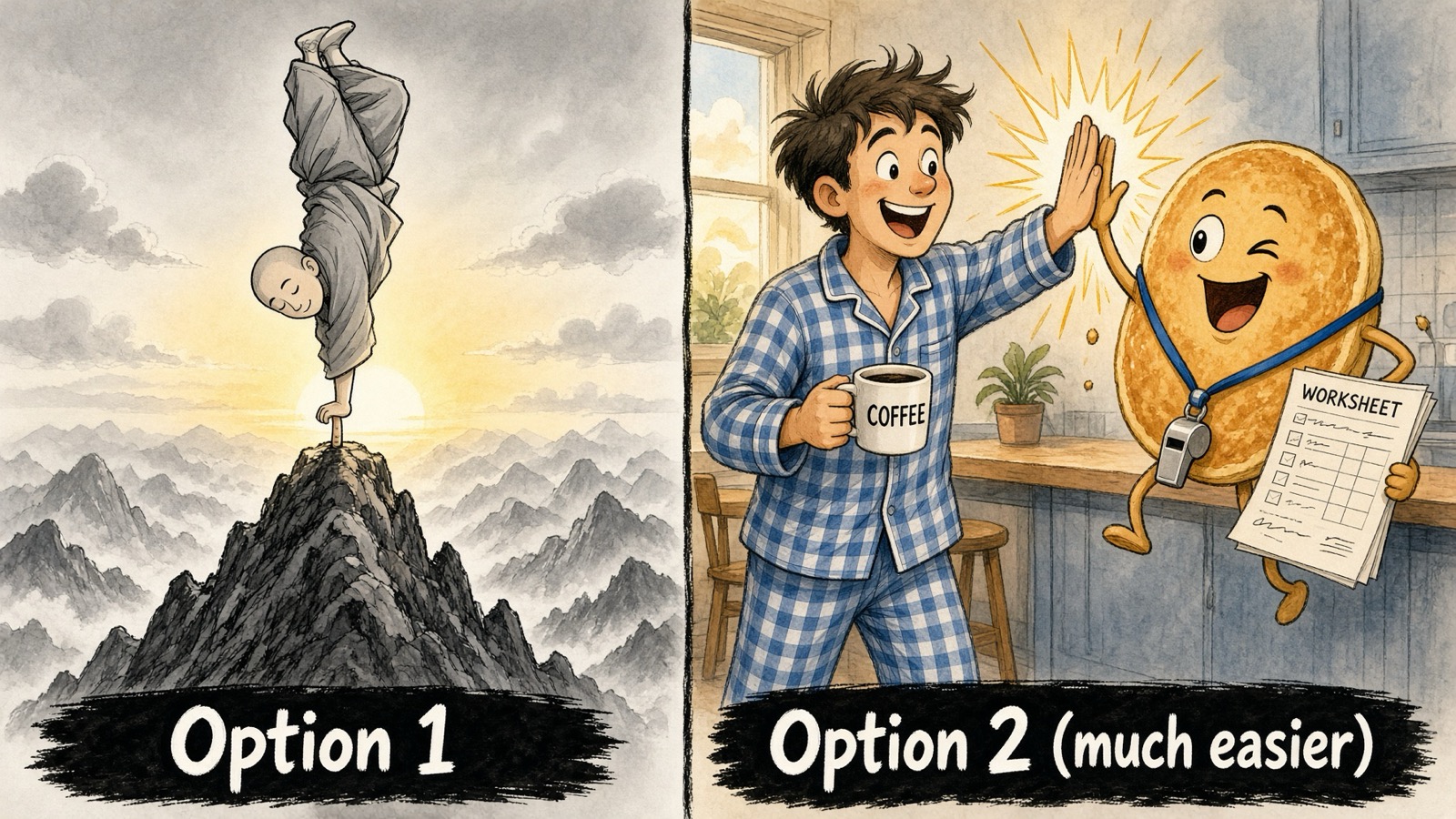
Step 1: Download the free 20 Minute Burnout Worksheet. It takes about 20 minutes, a pen, and your honest attention. You'll name what's actually draining you, sort it into the part you can fix and the part only your job's shape can fix, and pick the 1 thing to change first. If your Happiness Audit came back flat, this is where you find out why.
Step 2: Book a call with me. We'll map your values, redesign your goals, and craft your next steps, together. It's the same process that got Karla, Alessandro and Andrea jumping out of bed to tackle goals that make them feel alive, instead of the snooze, scroll, repeat routine.
Compared to 80,000 hours of potential regret, 1 worksheet and 1 conversation are a rounding error in your life's investment portfolio.
Because those boxes on the life-in-weeks chart don't wait for anyone.
So take that 1 tiny step today. It's the only one that matters right now.
This is Chapter 5, the final chapter of The Ultimate Simple Guide To Life (That Actually Helps You).
- Introduction
- Chapter 1: Goals
- Chapter 2: Time
- Chapter 3, Part 1: Fear
- Chapter 3, Part 2: Fear-Setting
- Chapter 4: Change
- Chapter 5: Happiness (you are here)