Simple Guide to Life, free worksheet
The 20 Minute Burnout Worksheet
Want a copy in your inbox?
Email me a copy plus 4 short follow-ups, 1 a day. The worksheet stays free, right here, whether you sign up or not.
No spam, unsubscribe in 1 click. Privacy.
About 20 minutes, a pen, and your honest attention. By the end you will have named what is actually draining you, sorted it into the part you can fix and the part only your job's shape can fix, and picked the single thing to change first.
This worksheet is the companion to the talk. If you would rather watch first: Your Deathbed Regrets Are Trying to Tell You Something.
- Step 1, 10 min
- Step 2, 3 min
- Step 3, 1 min
- Step 4, 5 min
- Step 5, 1 min
- Total, about 20 min
I wrote this. I'm a coach, not a clinician. This is a way to think about your job, not medical advice, and it is not treatment. If you are in real distress, talk to a doctor.
By Adrien Harrison: 5x founder, investor, speaker, coach, and a 5 time burnout champion who got out of the river.
You can do this on paper, the way it was written, or type into the boxes on this page. The boxes count your lines for you in Step 3. Nothing you type here is saved or sent anywhere unless you send it yourself at the end.
How to use this worksheet: 2 ways
(A) Upload to your AI tool and let it coach you (Recommended)
It is the recommended path because the AI asks 1 question at a time, fits the worksheet to your situation, and never overwhelms you with the whole thing at once. The worksheet is the guide. Your AI is the coach.
(B) Print and fill it out by hand
That is the rest of this page. Type into the boxes below, or print the page and work through the steps with a pen. Same worksheet, no AI required.
Set up the AI coach (Path A)
Whichever tool you use, the shape is the same: paste Copy-Paste 1 of 2 as the project instructions, add the Copy-Paste 2 of 2 documents as the project knowledge, then open a chat and say "Start".
Claude Projects
- Open Claude, go to Projects, and create a new project. Call it something like "My Burnout Worksheet".
- Open the project settings and paste Copy-Paste 1 of 2 into the custom instructions.
- Add the Copy-Paste 2 of 2 documents to the project knowledge, then start a new chat inside the project and say "Start".
ChatGPT Projects
- Open ChatGPT and create a new Project.
- Paste Copy-Paste 1 of 2 into the project instructions.
- Upload the Copy-Paste 2 of 2 documents as project files, then start a chat in the project and say "Start".
Google Gemini Gems
- Open Gemini, open the Gem manager, and create a new Gem.
- Paste Copy-Paste 1 of 2 into the Gem instructions.
- Attach the Copy-Paste 2 of 2 documents as knowledge files, save the Gem, and start a chat with it. Say "Start".
Everything above runs in your own AI tool, with your own answers. Pasting it sends nothing to Simple Guide to Life.
Step 1. Write down the last bad week
10 minutesNot a typical week. The last genuinely bad one. Go hour by hour if you can and write down what actually took the time and the energy. Meetings, yes, but also the parts nobody schedules: the rewrite of a document after a hallway comment, the third status update in a different format, the 20 minutes of dread before a call.
Be specific enough that a stranger reading it could tell what your job is really made of. 1 drain per line.
On paper is fine too. The list is what matters, not where it lives.
Step 2. Split the list in two
About 3 minutesGo down what you wrote and put every line in exactly 1 of these 2 columns. Not both. Forcing the choice is what makes this useful. Copy each drain from Step 1 into the column it belongs in, one per line.
Column A
Things I could change on my own next week
- Saying no to a meeting that does not need me.
- Answering messages twice a day instead of continuously.
- Writing the document once and letting the first draft be rough.
- Stopping work at a time and actually stopping.
Column B
Things that would need my job to change shape
- How many products or teams you are accountable for.
- Who you report to, and how many people can assign you work.
- The number of standing meetings that exist whether or not you attend.
- On call, escalation, or being the default answer for a whole system.
- Being measured on something you do not control.
Column A items are real, and they are worth doing. They are also the only ones most advice talks about. No amount of personal discipline moves a Column B item. Trying harder against a Column B problem is the most reliable way to burn out completely.
Step 3. Count. This is your score
1 minuteCount the lines in each column. Those 2 totals are your score. It is not a grade and it is not a diagnosis. It is a pair of numbers that tells you where your bad week actually lives: Column A is the habits count, Column B is the structure count. If someone asks what you scored on this worksheet, the answer is those 2 numbers.
On paper? Write it the same way: Column A total ____ , Column B total ____ . That pair is your score.
If Column A is bigger, you have a habits problem and habits will fix it. Start next week.
If Column B is bigger, and for most people running on empty it is, you have a structure problem wearing a habits costume. Personal fixes will buy you a few weeks and then it comes back, which is probably what happened last time.
Step 4. Pick 1 thing
5 minutesOne. Not a plan, not a system, 1 thing, from whichever column came out bigger.
Pick the line that, if it went away, would make the most difference to how the week feels. Not the easiest one. Not the one that would impress anyone.
If it came from Column B, the first move is almost always a conversation, and it is a request rather than a complaint. "I am accountable for 3 products and I can do 2 of them properly. Which 2 do you want?" is a sentence that changes structure. "I am overwhelmed" is a sentence that gets you sympathy and the same week again.
Step 5. Put a date on the check
1 minute4 weeks out, in your calendar, right now. When it comes round, read what you wrote in Step 1 and ask 1 question: is that week still shaped the same?
The box is prefilled with the date 4 weeks from today. Move it if you need to, then put it in your real calendar.
If nothing moved and the thing was from Column B, that is information about the job, not about you.
Sources
This worksheet is the companion to the talk, and the talk leans on research you can check yourself:
- The regrets of the dying. A hospice nurse, Bronnie Ware, recorded the most common regrets of people in their final weeks. The deathbed test in the talk comes from her work.
- The value wheel. Psychologist Shalom Schwartz mapped the values humans share, from research in 82 countries. There are 10. The wheel belongs to the talk's method: in the talk you rate each value twice, how important it is to you and how aligned your current life is with it. This worksheet works the last move of that method, sorting Column A from Column B.
- The hours. Your career is about 80,000 hours. That is the scale the talk uses when it asks what you want those hours to buy.
Last step. Send me your first thing to change
Reading this page is not finishing the worksheet. Finishing is picking the 1 thing and telling someone. Tell me. I read these, and what people send is how I know whether this exercise actually changed anything.
No email app handy? Just write to info@simpleguideto.life with your first thing to change and your 2 column totals. That counts exactly the same.
That is the worksheet. The newsletter is more of the same.
If it was useful, the newsletter is more of the same, written for people who are tired of pretending the pace is fine. It is free and you can leave whenever you want. Put your email in here and you are on the list, no trip back to the homepage needed.
Your Next Tiny Step
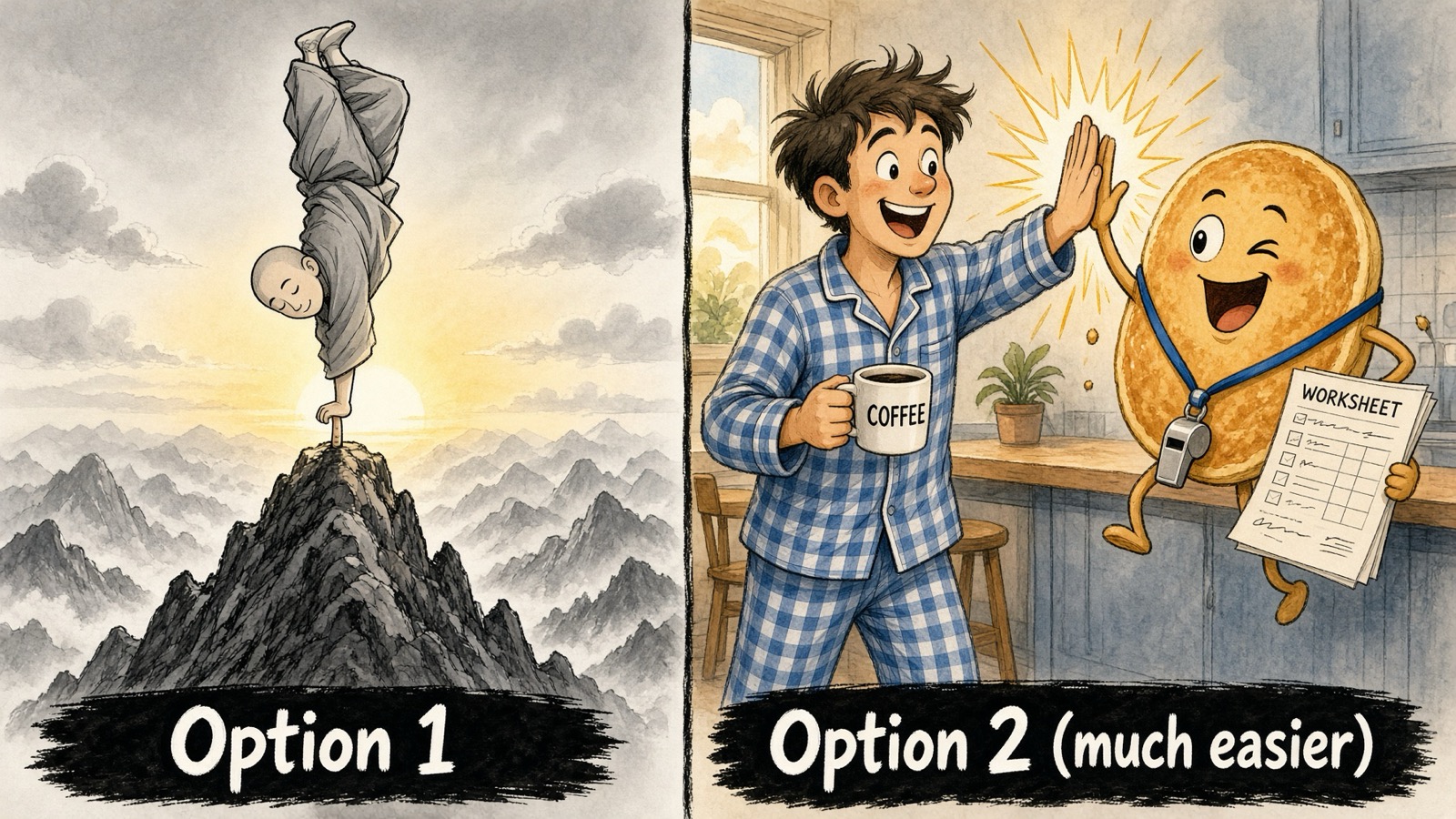
If you want this to stick for the next 14 days, and the next 14 years, you need either the discipline of a Shaolin monk OR just a cadence and a partner.
That's why I created Simple Guide: so you'll always have that partner, accountability, and a clear next step.
Step 1: Do the worksheet above.
Step 2: Book a call with me. We'll map your values, redesign your goals, and craft your next steps, together. It's the same process that got Karla, Alessandro and Andrea jumping out of bed to tackle goals that make them feel alive, instead of the snooze, scroll, repeat routine.
Compared to 80,000 hours of potential regret, 1 worksheet and 1 conversation are a rounding error in your life's investment portfolio.
Because those boxes on the life-in-weeks chart don't wait for anyone.
So take that 1 tiny step today.